Host a Polish Poker Night
Everything you need to run a great Polish Poker evening – at home, in a bar or in a club. One deck per table, four players per table, and you can teach the game in two minutes.
What you need
- One deck per table. Any standard deck with a Joker works: keep the 9, 10, J, Q, K and A of every suit (24 cards) plus 1 Joker, and put the 2s to 8s away.
- A table for every 4 players. 4 is the best experience; 3 or 5 work too (see Official Rules, section 8).
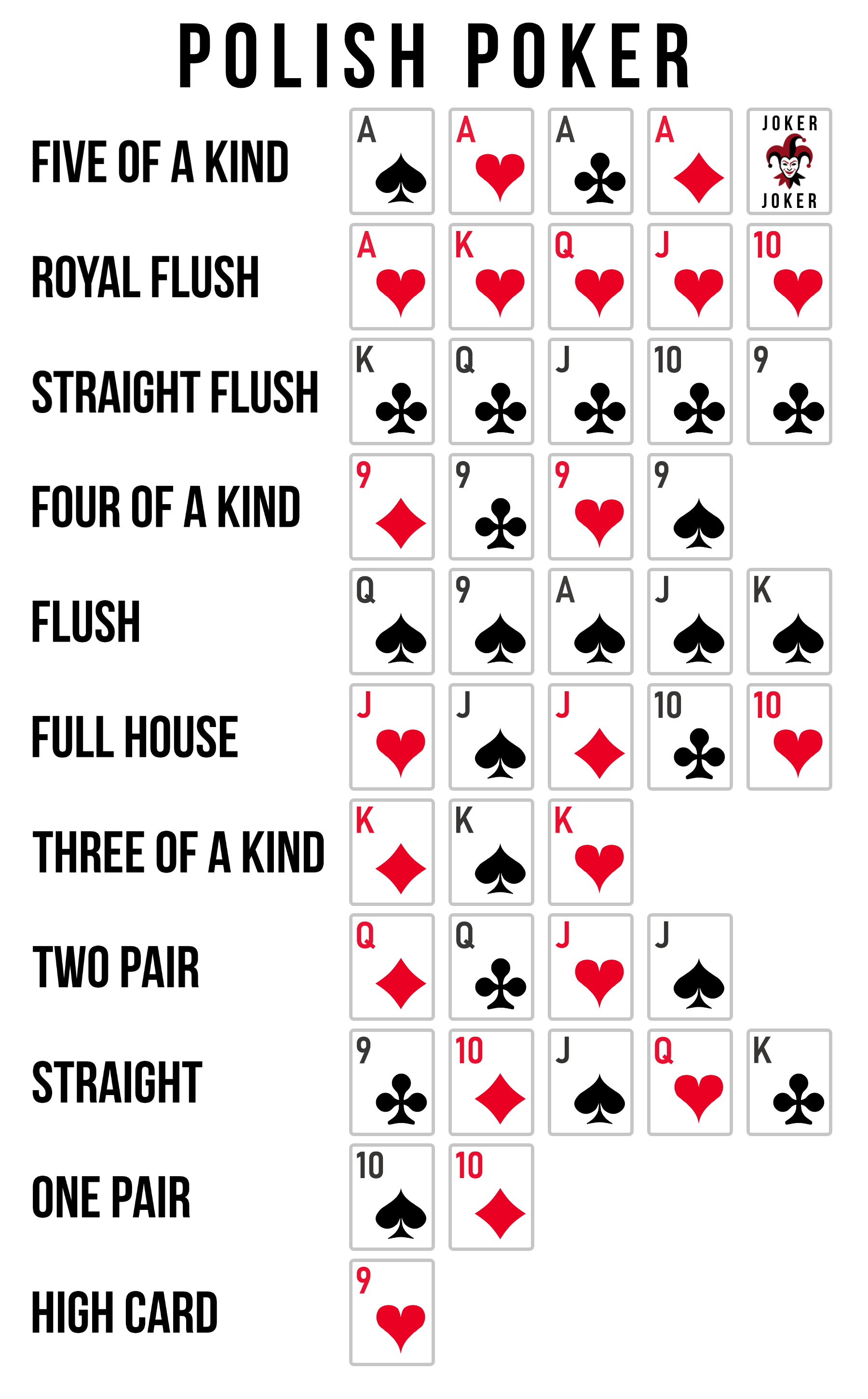
- One cheat sheet per table. Download the cheat sheet and print it, or keep it on a phone.
- The rules for the host. Download the Official Rules (PDF) – the host settles any disputes.
- About 30 minutes per game. A tournament for 8 players takes about an hour.
Before your guests arrive
- Sort the decks (9 to Ace + Joker) and check each one has exactly 25 cards.
- Put a deck and a cheat sheet on every table.
- Decide on the format: casual tables or a tournament (see below).
- Choose the host. In a tournament, the host is the tournament director and has the final say.
Explain the game in 2 minutes
Read this out loud, then play a practice round:
- “We use 25 cards: 9 to Ace in four suits, plus a Joker that can be any one card.”
- “Everyone starts with 1 secret card. One more card is turned face up for everybody.”
- “The first player claims a poker hand exists among all the cards in play – yours, mine and the open card. It can be true or a bluff.”
- “The next player either claims something higher, or says CALL.”
- “On a CALL, everyone shows their cards. If the hand is there, the caller loses. If not, the one who claimed it loses.”
- “The loser gets one more card next round. Lose with 5 cards and you are out. Last player standing wins.”
- “Careful: the ranking is different from normal poker – check the cheat sheet.”
Need a longer explanation? Send new players to How to Play.
Pick a format
| Players | How to play |
|---|---|
| 2–4 | One table, Standard Format |
| 5–6 | One table with the 5- or 6-player format (8.2, 8.3) – or two smaller tables |
| 7–10 | Two tables, the top 2 of each go to a Final Table of 4 |
| 11 | Three tables (4 + 4 + 3), then a second stage, then the Final Table |
| 12–20 | Four tables, each winner goes to the Final Table |
| 21+ | Six or more tables – follow the tournament table in 8.4 |
Tournament basics: seats are drawn at random, every stage starts fresh with 1 card, and “top 2” means a table plays until only 2 players remain.
Tip: the Tournament Planner works out the tables for your exact number of players and draws the seats for you.
A sample evening for 8 players
| Time | What happens |
|---|---|
| 19:00 | Guests arrive, the host explains the game (2 minutes) |
| 19:10 | Practice round at both tables |
| 19:30 | Stage 1: two tables of 4, play until 2 remain at each |
| 20:00 | Short break, draw new seats |
| 20:10 | Final Table of 4 |
| 20:40 | Winner, photos – and a rematch |
Tips for hosts
- Mix new and experienced players at each table, so beginners can watch a few rounds before the bluffs get big.
- Keep the cheat sheet in the middle of the table – the hand ranking is the most common question.
- Use the odds calculator after the game to settle “was that call a good idea?” debates.
- Play for fun, a small prize or bragging rights – the game works the same either way.
- Alternate the direction of play between games, as the rules suggest (clockwise first, then the other way).
Share your night
Played Polish Poker with your group? Share a photo and tag @polish_poker on Instagram or post it on our Facebook page. Questions or a tournament you want to tell us about: officialpolishpoker@gmail.com.
More about Polish Poker: How to Play · Official Rules · Quick Rules · Hand Order & Odds